
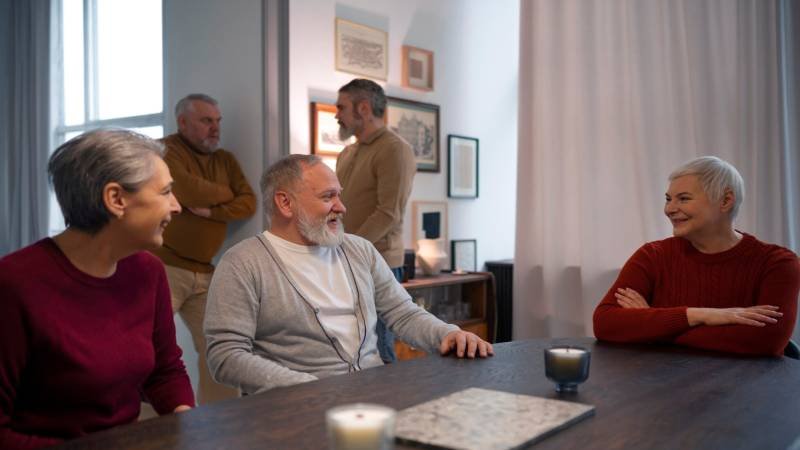
While the brochure provides a visual overview of what we can expect on a typical day, it is unable to capture the atmosphere – the sense of happiness, satisfaction, and fulfillment of the residents in attendance.
Visit during a scheduled activity, not after
The most valuable way you can assess a senior living community is to visit while something is going on. Not before. Not after. During.
Notice who’s there. Account for the filled seats. Observe if people are engaging or merely co-existing in parallel. A community with fifteen residents at trivia night is communicating something different to you than one where two people are waiting for the facilitator to finish up.
Social isolation has quantifiable health impacts – the National Academies of Sciences, Engineering, and Medicine report a 50% increased risk of dementia and a 29% increased risk of coronary heart disease. Assessing social culture is not a squishy, nice-to-have question. It’s a healthcare decision.
What the activity calendar actually tells you?
Take a look at the calendar, but do so with a critical eye. A good schedule will have physical health offerings, mentally stimulating programs such as lectures or book clubs, outlets for creativity, spiritual ones, and real social engagement. If it looks like an awful lot of movie nights and bingo, that’s passive. It’s easy to schedule, it’s low on the effort to engage, and it doesn’t really serve as a social glue.
The type matters, but so does the depth of what’s offered. Do regular interest groups meet weekly? Are there outside speakers or performers brought in, or relationships with local schools or organizations? Intergenerational programming, where local students or youth groups come in regularly, generally means this is a community that’s looking beyond itself.
Observe the dining room like it’s an interview
Mealtime plays an important role as the social hub of every senior living community. Whether the community culture is one that you want to be part of or not, you can usually pick up on by watching a bit of lunch.
Is there actual back-and-forth conversation taking place? Are all the residents at a table different from one another, or does every table look like a Dukakis family photo? Watch the staff for a bit – do they take time to make introductions of new residents, or are they busy getting through the service as efficiently as possible?
Open seating allows for a more naturally social atmosphere. Assigned seating isn’t necessarily a bad thing, but you can tell if it’s bred contentment or if it’s just the expected routine. An inviting atmosphere for new arrivals, or a not so inviting one, is usually something you can see without anyone even speaking a word.
Ask the Life Enrichment Director specific questions
Every community has a person who is responsible for coming up with and scheduling the social calendar – in this industry that person is known as a Life Enrichment Director. This is the nitty-gritty of what daily life will look like for your loved one. Don’t bypass this question during your tour, and don’t accept a vague “we offer X, Y, and Z” kind of answer. Be specific.
Ask how new residents are welcomed into the social scene. Find out whether there’s a welcoming committee – a group of residents who seeks out the new move-ins, invites them to activities, and helps introduce them around. It’s a great way to know if the right people are prioritizing the right things.
Ask how residents who are more introverted are supported in feeling comfortable and welcome at activities. Ask how suggestions and feedback from residents are taken and used to inform the monthly calendar updates.
Resident autonomy is the clearest signal
Neighborhoods in which residents are active co-creators of day-to-day life feel and function fundamentally different from those where a program is delivered off an administrative calendar. You can see such places in action by watching resident councils (self-governing groups that weigh in on everything from menu decisions to community policies and employee hires) or peer-led interest groups and clubs (those are the clubs that people who live there started for themselves, whether that’s a gardening club, a woodworking group, or a weekly card game that no one on staff ‘sets up’ for you).
These organic structures are far more difficult to pretty up for a tour than a smiling staff or a curated art piece. They are both signs that residents are truly in charge and that their neighbors and staff truly invest in that responsibility.
If you are comparing many different senior living options, it can be very challenging to compare all of these considerations at once and then hold them against the reality of who a specific individual is and how they function socially. A service like a Senior housing placement Minnesota organization can help with that comparison, as its whole reason for existing is to match a senior to a community based on their personality, not just their care needs.
Connection to the surrounding area matters
An engaged community that remains connected to the larger local community can give a hint to that. Are they regularly taking residents to theaters, parks, restaurants, or museums? Are they regularly bringing local volunteers, performers, or community groups to the inside of the building?
Transportation services in the form of a shuttle or community bus that residents can use indicate freedom. It shows that the community views residents as people with lives outside the building, rather than just people to keep busy.
What you’re really looking for
While no single tour observation will answer that, you can get a good sense by looking at who turns up for scheduled activities, how folks engage with one another during a meal, if and how residents have a real say and stake in their daily experience, and how many and what kind of connections the facility has to the larger community.
Together, those factors can describe the prevailing culture for social connection. And, of course, as with anything, come in with your own list of questions. Then stay after the performance is over. And observe what you can when no one’s on stage. See more: whatutalkingboutfamily.com.